Loading Vantage Events
FOR THE PERSON WHO RUNS EVERY EVENT WITHOUT "EVENTS" IN THE TITLE

One platform for every all-hands, happy hour, offsite, and onboarding.

Built for community managers, People Ops partners, and internal events leads who picked up "events" as a bonus responsibility. SSO so your team does not argue with another login. Hybrid RSVPs, in-room and virtual. Surveys baked in so every event ships with sentiment data. Role-based access so contractors do not see the employee directory.

Built for community managers, People Ops partners, internal events leads, and the EA who quietly runs every offsite without anyone formally asking her to.

Vantage admin dashboard showing all-hands, happy hour, and offsite events with hybrid RSVPs and post-event sentiment scores in one view
SSO via Okta
Q3 retreat NPS · 72

Most event software was built for a conference in Orlando, not a Friday happy hour for fifty.

The community managers running every event at their company already know the problem is not time. It is running nine tools that do not talk to each other.

Eventbrite for RSVPs. Mailchimp for reminders. Calendly for the one-on-ones. A Notion page for the venue. A Google Doc for the agenda. A Slack channel for coordination. A spreadsheet for check-in. A Canva file for badges. A separate survey tool for feedback.

Nine tools to run one all-hands. Each one has its own login, its own export format, its own quirk that only the person who set it up remembers.

The best community managers have already made peace with the fact that no platform has caught up to the job. Vantage is the one that has.

You are not buying event software. You are buying back your Thursday afternoons.

One stack instead of nine. SSO so the team logs in once. Hybrid attendance because half your company is remote. Sentiment data attached to every event automatically, so leadership stops asking "how was it?" and starts seeing the answer in a dashboard.

WHY VANTAGE

Built for the person whose first question is "where did I save the agenda?"

Each pillar names a specific capability and the hour it earns back, the gate it unblocks, or the executive question it answers.

1.

One stack, not nine. RSVPs, reminders, agenda, check-in, badges, surveys, follow-ups in one product.

The all-hands is the unit, not the tool. Send the invite, draft the reminders in your voice, capture RSVPs in-room and virtual, scan check-ins, print badges, run the post-event sentiment, export the recap to Slack or Teams. One login, one format, one place where the institutional memory of every internal event lives.

2.

SSO via Okta, Google Workspace, or Microsoft Entra. IT will not block this.

SAML 2.0 and OIDC supported. Provisioning via SCIM on Pro and Enterprise. Your team signs in with the company login they already use. IT review goes from a six-week procurement deep-dive to a fifteen-minute security questionnaire most teams have answered before.

3.

Hybrid attendance that does not feel like an afterthought.

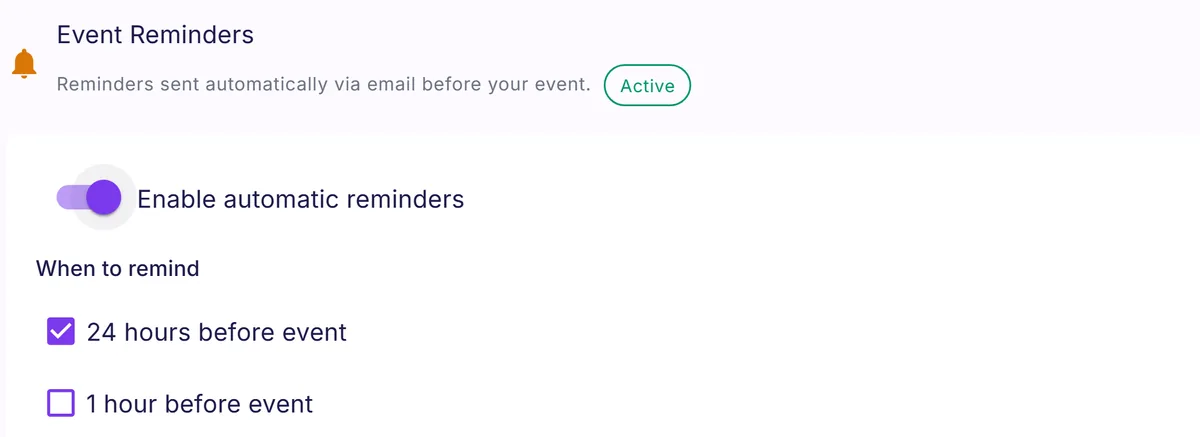
In-person and remote RSVPs in one record. Zoom or Google Meet links generated and gated to the RSVP list. Virtual attendees scan a digital badge to register engagement. The post-event report gives leadership one number for the room and one for the stream, side by side.

4.

Surveys baked in, so every event ships with ROI data attached.

Pulse survey fires twenty-four hours after every internal event. Net promoter, sentiment trend by team, open-comment summarization. Stop asking executives "how was it?" Start showing the score, the trend, and the call-out comments in a one-page export the morning after.

5.

Custom domain, full branding, no platform watermark.

Internal events do not get "Powered by Vantage" footers. Pro and Enterprise tiers ship with custom domain support (events.yourcompany.com) and full branding control. Your all-hands looks like the company, not like a marketplace tool. (Business tier; verify exact tier when you sign up.)

6.

Role-based access so the temp helping at check-in does not see the employee directory.

Volunteer and contractor roles see names and team only. Compensation, manager chain, and personal contact info stay admin-only. The agency staff helping at the offsite walk away with no roster they can take with them. Your HRBP signs off without a deep-dive.

THE STACK

Nine tools to run one all-hands. Or one.

A picture of what most internal events teams actually use today, and what Vantage replaces.

WHAT MOST TEAMS RUN TODAY

Eventbrite (RSVPs)
Mailchimp (reminders)
Calendly (1:1s)
Notion (venue)
Google Doc (agenda)
Slack (coordination)
Spreadsheet (check-in)
Canva (badges)
SurveyMonkey (NPS)

Nine tools, nine logins, nine export formats. The institutional memory walks out when the community manager does.

WHAT VANTAGE REPLACES IT WITH

1
Vantage for Internal Events
RSVP, reminder cadence, agenda, hybrid attendance, check-in, badges, sentiment, post-event recap. SSO at the door, Slack and Teams export at the back.

One platform. One login. One source of truth for every internal event the company runs.

From the calendar invite to the post-event recap, mapped stage by stage.

The five stages every internal event runs. Two very different Thursdays.

Stage Without Vantage With Vantage What you earn
Save-the-date Calendar invite blasted to dist-list. Half the team archives it without reading. RSVP-tracked invite via SSO. Reminder cadence drafted in your voice, send-time-tuned per recipient. Engagement signal before the event, not after.
Coordination week Slack threads, Notion docs, agenda Google Docs, vendor email chains, and the spreadsheet that lives on one laptop. One event page with agenda, venue, vendor contacts, and run-of-show in one place. Comments thread under each line item. Institutional memory that survives the next reorg.
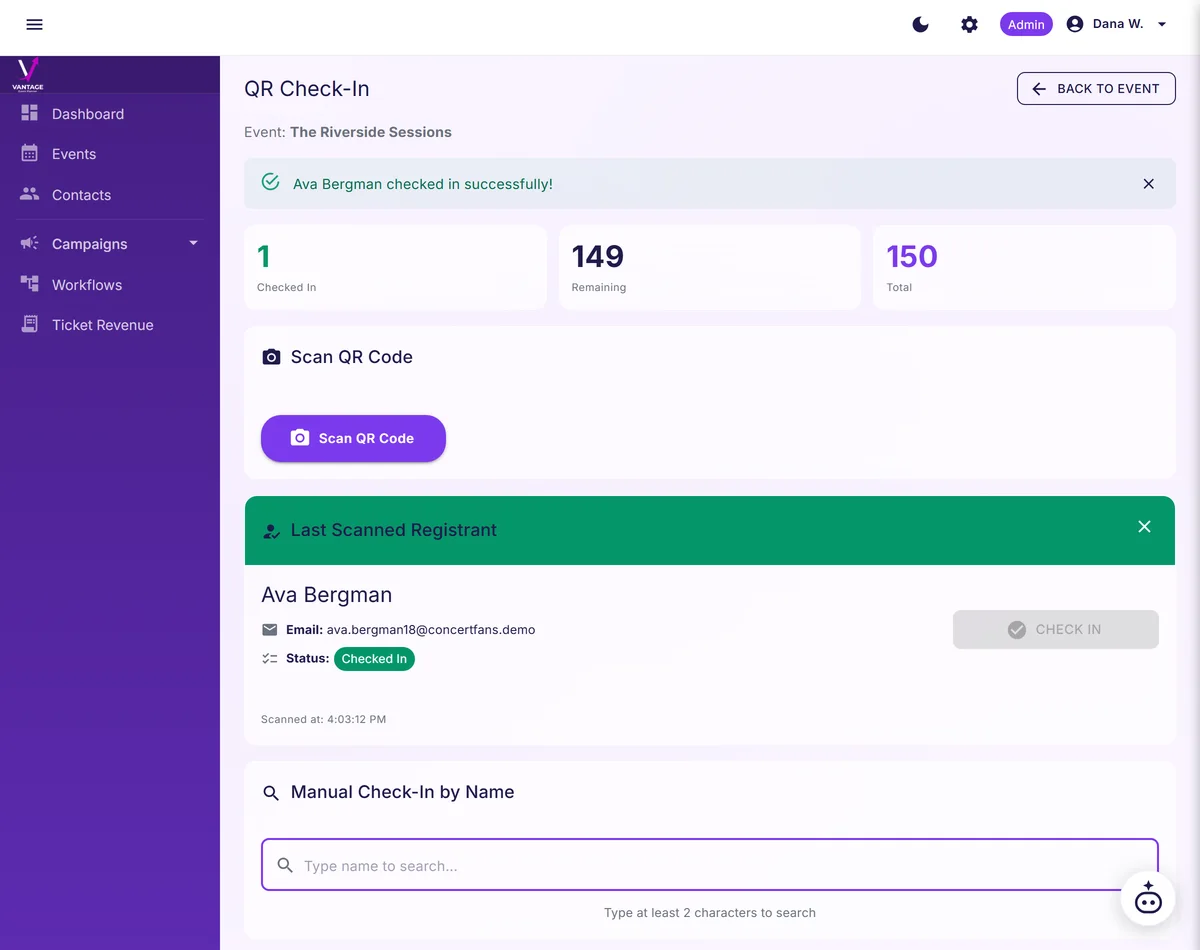
Day-of, in-room Greeter with a printed list, badge printer that jammed last quarter, and an Apple TV showing a Canva slideshow. QR scan via SSO badge. Pre-printed name tags arriving the morning of. Live attendance dashboard for the CEO's chief of staff. Door runs without you standing at it.
Day-of, remote Zoom link in three different places, half the company shows up to the wrong one. Single gated link, generated per-attendee, sent at the right time, expires after the event. Remote half attends, no Slack panic at minute six.
Post-event recap Two days of stitching the survey responses, the attendance spreadsheet, the budget reconciliation, and the executive write-up by hand. One-page export the morning after. Attendance, NPS, sentiment by team, top three open comments. Slack-shareable link to the full report. CEO's chief of staff gets the recap before they ask.
INTELLIGENCE

The signals leadership actually wants.

Every insight below answers one question: did this event move sentiment, retention, or alignment? If we cannot answer that, we do not build it.

01 · SENTIMENT TREND

All-hands sentiment, quarter over quarter.

NPS and pulse-question scores, charted across every all-hands you have run. Drill into the team-level cuts to see where the trend is diverging from the company average. The moment leadership has been asking for, in a chart instead of a feeling.

02 · ENGAGEMENT BY TEAM

The teams who are showing up, and the teams who are not.

RSVP rate, attendance rate, and survey completion by team and tenure. Engineering shows up to demos and skips happy hours. Sales is the inverse. Vantage shows you the pattern, leadership decides what to do with it.

03 · DISENGAGEMENT ALERT

The employees who stopped opening any event communication.

A leading indicator that often precedes attrition or a quiet crisis. Surfaced anonymously to the manager chain, with role-based privacy. Your HRBP gets a heads-up; the employee does not get tagged on a dashboard.

04 · HYBRID PARITY

Are remote attendees actually engaged, or just logged in?

Engagement scoring on the virtual side, side-by-side with the in-room. Q&A volume, chat activity, time-in-session, post-event survey response rate. The remote half stops being a black box.

05 · TOP COMMENTS

The three open comments worth reading, summarized.

Survey free-text responses summarized into the three patterns that emerged, with representative quotes for each. Stop drowning in two hundred comments. Read the three that capture them.

06 · EXECUTIVE EXPORT

A one-page recap, sent to Slack or Teams the morning after.

Attendance (in-room and virtual), NPS, sentiment by team, top three comments, top three call-outs. The version your CEO's chief of staff would have built by hand if they had three more hours. Auto-shared to the channel of your choice.

A SCENE FROM THE COMMUNITY MANAGER'S DESK

The reorg retreat.

Vantage flagged a pattern.

Three weeks out from the company retreat, the community manager saw a dashboard entry she had not noticed before. Twelve employees across three teams had not opened any communication about the event.

Not one reminder. Not one agenda. Not one RSVP prompt.

She pulled their records. All twelve were on the teams being restructured the week after the retreat. A leak had happened, quietly, through the silence.

She flagged it to the chief of staff. The reorg announcement got moved up by a week. The retreat got reframed around the transition, with the affected teams briefed before they walked into the room.

The retreat's NPS came in at 72. The version where leadership had not been tipped off would have been twelve employees resenting a keynote they had been pretending to anticipate.

The pattern had been in the data the whole time. Until Vantage, nobody on the people-ops team had been looking at it.

Illustrative scenario. Vantage surfaces engagement patterns at the team level with role-based privacy; leadership decides what to do with them.

BEFORE YOU ASK

Before you ask, here is what other community managers asked.

"Does this integrate with Slack, Teams, and Google Workspace?"

Yes. Slack and Teams: post-event recaps export to a channel of your choice automatically. Google Workspace and Microsoft 365: SSO via SAML and OIDC, calendar invites generated as ICS attachments that work in both. Calendar two-way sync (event RSVPs flowing back to Outlook or Google Calendar) is on the roadmap; manual ICS works today.

"Do we get SSO?"

Yes. SAML 2.0 and OIDC are supported. Okta, Microsoft Entra (Azure AD), Google Workspace, and OneLogin tested. SCIM provisioning included on Pro and Enterprise. Your team signs in with the company login they already use.

"Will IT approve this?"

Most IT reviews of Vantage go through in a single security questionnaire. We document the security posture, data residency, encryption-at-rest, and access controls in a one-page brief your IT team can review before the call. Soc 2 Type 2 audit is in progress; the gap analysis report is available under NDA today. We do not store payment instruments (Stripe) and we do not use customer data for model training.

"Can our team use it without training?"

Most internal-events teams are running their first all-hands on Vantage within thirty minutes of signing up. The default templates ship with the agenda blocks, RSVP fields, and survey questions most teams already use. The cadence drafting in your voice replaces the manual reminder writing. The learning curve is shorter than the next time you reset the SurveyMonkey password.

"What about the 1500-person company offsite next quarter?"

Pro and Enterprise tiers handle larger headcounts and the multi-day, multi-track agenda model that big offsites need. Custom domain, white-label invites, dedicated onboarding support, and SLA-backed uptime included on Enterprise. We will model your specific event structure on a discovery call if you want to scope it before signup.
TRUST & SAFETY

The IT-friendly defaults that let you skip the procurement deep-dive.

SSO with your provider, on day one.

SAML 2.0, OIDC, SCIM. Okta, Microsoft Entra, Google Workspace, OneLogin tested. No "wait for the SAML upgrade tier" gotcha. SSO is included on every paid plan that needs it.

Role-based access, contractor-safe by default.

Volunteer and contractor roles see names and team only. Compensation, manager chain, and personal contact details stay admin-only. Audit log of every access by every user, exportable to your SIEM if your security team asks.

Risk reversal.

Your first internal event on Vantage is free, forever. No credit card. No expiring trial. If your team does not get the all-hands recap to leadership faster than the old nine-tool stack did, close the account and pay nothing.

FOUNDING COHORT

25 internal-events teams. Pro tier features at Growth tier price. Locked for life.

The first 25 internal-events teams on Vantage get a free lifetime upgrade from Growth to Pro. Pay $39 per month. Get the $99 tier's features forever. When the 26th team signs up, the offer closes. Standard pricing applies from that point on.

Real limit, no manufactured scarcity. Founder-led onboarding for every team in the cohort. SSO setup included.

1 of 25 founder spots claimed

One subscription, every event the company runs.

All-hands, happy hour, offsite, onboarding cohort, customer advisory board, board offsite, holiday party, hackathon. Same employee directory, same brand, same survey instrument tuned over time. The platform that ran the last all-hands is the same one running the next offsite.

Growth for the team running ten to thirty internal events a year. Pro for community managers and People Ops at growth-stage companies that need SSO, SCIM, and custom domain. Enterprise for companies running multi-region offsites with dedicated security review and SLA.

Founder cohort pricing
$39/mo
Pro features included, locked for life
See full pricing

The next all-hands, on the platform that buys you back the Thursday afternoon.

PRIMARY

See Vantage run an all-hands.

Fifteen minutes. Pre-loaded with a hybrid all-hands scenario, SSO check-in, sentiment trending, and a Slack export landing in real time. No sales pitch.

Book demo
SECONDARY

Run your first internal event free, forever.

Sign up with your work email, no credit card. One full event on Vantage. If the team picks it up, founder-cohort pricing kicks in.

Create free account
TERTIARY

The IT brief.

A one-page security and architecture overview your IT team can review before the procurement call. SSO, encryption, data residency, audit log, model-training stance.

Request the brief